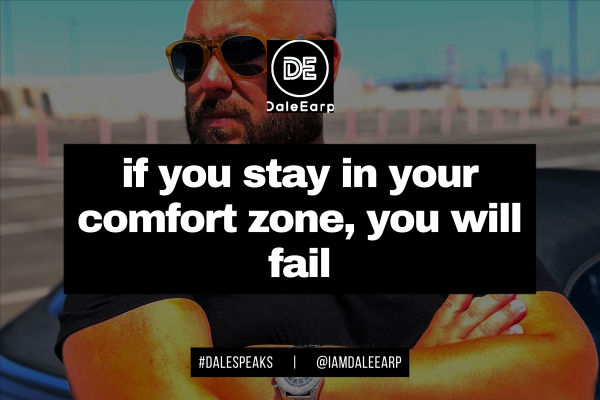
If You're Always Comfortable, You're Not Growing
There's nothing wrong with being comfortable. After you've worked hard, solved problems, built relationships, created something meaningful, and carried responsibilities for years, being able to enjoy some peace is a good thing. The problem begins when comfort stops being the reward and becomes the goal. When protecting what feels familiar becomes more important than pursuing what you're capable of becoming, your comfort zone can quietly become the place where your growth stops.
Success isn't a comfortable procedure. Most of the things that create meaningful growth require you to do something that feels unfamiliar first. You have to make decisions without having every answer, take calculated risks, have difficult conversations, learn skills you don't have yet, change strategies that used to work, and sometimes admit that the way you've been doing something is no longer enough. None of that feels particularly comfortable while you're going through it, but that's often the point. Growth stretches your capacity before it expands your results.
We often make the mistake of thinking that discomfort means something is wrong. If we're uncertain, we wait. If we're nervous, we hesitate. If we aren't confident, we assume we're not ready. But confidence doesn't always come before the action. A lot of the time, confidence is created by taking action, dealing with the outcome, learning from the experience, and realizing that you were capable of handling more than you thought.
Think about any skill you're good at today. There was probably a time when it felt awkward, difficult, or unfamiliar. You weren't automatically good at it. You had to practice, make mistakes, receive feedback, adjust, and keep doing it long enough for the unfamiliar to become familiar. What feels comfortable today may have once been the very thing that pushed you outside your comfort zone. That's how capacity is built.
The same principle applies to business. You can't expect a business to grow while you continue operating exactly the way you did when it was smaller. At some point, growth requires you to change how you work. Maybe you need to delegate responsibilities you've always held onto. Maybe you need to build systems instead of relying on memory. Maybe you need to improve your marketing, change your offer, invest in technology, hire someone, or finally look at the numbers you have been avoiding. The next stage usually requires something different from the person who built the previous stage.
That's where people can get stuck. They want the results of a bigger business while maintaining the habits of a smaller one. They want more customers but don't want to change their marketing. They want more time but continue doing everything manually. They want better systems but keep relying on memory and scattered processes. They want to grow but don't want to experience the uncertainty that comes with changing what they're already comfortable doing.
You can't always have a new result with an old operating system.
And that doesn't mean you need to change everything at once. Sometimes getting outside your comfort zone is a very small decision. It might mean making the phone call you've been avoiding, having the conversation you've been putting off, asking someone more experienced for help, learning a new skill, testing a new strategy, or finally launching something you've been talking about for months. The action itself might not seem dramatic, but it changes your relationship with discomfort. You stop treating unfamiliar territory as something to avoid and start seeing it as part of the process.
There's an important distinction here. Being comfortable with discomfort doesn't mean being reckless. You don't need to make bad decisions simply because they feel risky. You can still research, prepare, calculate, ask questions, build a plan, and make responsible decisions. But preparation eventually has to become action. There is a point where another month of planning isn't preparation anymore. It's simply a more comfortable form of procrastination.
Sometimes the thing you're calling "being patient" is actually fear of taking the next step. Sometimes the thing you're calling "waiting for the right time" is really a desire to avoid uncertainty. Sometimes you're not lacking information. You're lacking the willingness to act on what you already know.

That's uncomfortable to admit, but it can also be freeing. Because once you recognize it, you can do something about it.
Discipline becomes especially important here because motivation will rarely stay with you through every uncomfortable season. There will be days when you feel excited about the vision and days when the vision feels very far away. There will be days when the business is moving and days when nothing seems to be happening. If your willingness to act depends entirely on how comfortable or motivated you feel, your progress will always be inconsistent.
Discipline gives you another option. It allows you to say, "This isn't comfortable, but it's still necessary." You don't need to feel excited about every task. You don't need to feel completely confident about every decision. Sometimes you simply need to understand why you're doing something and have enough discipline to keep moving.
I've also learned that getting outside your comfort zone doesn't always mean doing more. Sometimes it means letting go.
For a business owner, that can be one of the hardest forms of growth. When you've built something yourself, it's easy to believe that nobody will care about it as much as you do. You become the person who answers every question, checks every detail, solves every problem, follows up with every lead, and carries every responsibility. Eventually, what once felt like dedication can become the very thing preventing the business from growing.
That's why systems and leverage matter.
At EARPware, the focus is on helping businesses create the infrastructure behind growth through CRM, automation, AI, digital marketing, SEO, websites, advertising, and done-for-you services. Tools such as AI Infinity can help automate repetitive communication, follow-up, lead nurturing, and recurring processes. But technology isn't the point by itself. The bigger purpose is to create capacity so the owner and the team can spend more time on the work that actually requires human judgment, leadership, relationships, and decision-making.
Sometimes getting out of your comfort zone means learning a new technology. Other times it means admitting that you shouldn't be doing a particular task anymore.
Both can be growth.
Your comfort zone isn't always a physical place. It's a pattern of thinking and behaving. It's the strategy you keep using because you understand it. It's the responsibility you keep holding because you don't trust anyone else with it. It's the conversation you keep avoiding because you don't know how the other person will respond. It's the business model you've outgrown but haven't changed because changing it would mean stepping into uncertainty.
The longer you stay inside those patterns, the more normal they become.
That's why comfort can be dangerous. It doesn't usually announce itself as a problem. It can look like stability. It can feel like security. It can even feel like success because you're not struggling as much as you used to. But if the goal is growth, you have to keep asking whether the comfortable thing is still serving the future you're trying to build.
There will always be another level that asks something different from you.
Maybe it's becoming a better leader. Maybe it's becoming more disciplined with your finances. Maybe it's learning how to sell. Maybe it's learning how to delegate. Maybe it's becoming more visible. Maybe it's finally building the systems that can support the business you've been trying to create. Whatever that next level looks like, there's a good chance it will require you to become comfortable doing something that currently feels uncomfortable.
That's not failure. That's development.
The people who grow aren't necessarily the people who never feel fear, uncertainty, or discomfort. They're the people who learn how to move forward while those feelings are present. They understand that discomfort can be temporary while the capacity they develop from facing it can stay with them for years.
You don't have to become fearless. You have to become willing.
Willing to learn. Willing to change. Willing to ask for help. Willing to make the call. Willing to make the mistake and learn from it. Willing to let go of something that worked before because it no longer works now. Willing to step into rooms where you're not the most experienced person. Willing to build something before you have complete certainty about how it will turn out.
Because the next version of your life or business may require a version of you that hasn't been developed yet. And you don't develop that version of yourself by staying where everything feels easy.
You develop it by stepping forward, feeling the stretch, learning what the experience is trying to teach you, and continuing to move.
So ask yourself honestly: What are you avoiding right now simply because it's uncomfortable, even though you know it may be necessary for your next level?
You don't have to solve everything today. You don't have to take the biggest risk in the room. But you do have to be honest about whether your comfort is helping you build your future or keeping you attached to your past.
Success isn't about living in discomfort every minute of your life. It's about refusing to let comfort make your decisions for you.
Get comfortable being uncomfortable.
Because sometimes the discomfort you're trying so hard to avoid is the very thing standing between where you are and where you're capable of going.
Want to Go Deeper? If this challenged the way you think about comfort, growth, and the work required to reach the next level, don't stop here. Sometimes the biggest breakthroughs begin when you finally recognize that the thing making you uncomfortable is also the thing forcing you to become better.
Read next: If You’re Not Embarrassed by Who You Used to Be, You Haven’t Grown
Legacy doesn't build itself.


