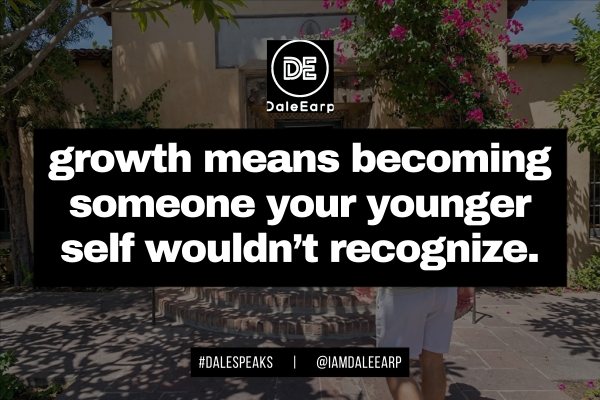
If You’re Not Embarrassed by Who You Used to Be, You Haven’t Grown
If you don't look back on your younger self and think, "Damn, I was dumb," you're probably still dumb.
I don't mean that as an insult. I mean it as a challenge to the way we think about growth. Because real growth usually comes with a little embarrassment. It means there are decisions you made years ago that you wouldn't make today. There are things you believed so strongly that you now see differently. There are conversations you handled poorly, opportunities you missed, people you should have listened to, and situations where you realize you simply didn't know what you didn't know.
And that's okay.
In fact, that's one of the clearest signs that you've actually grown.
If your younger self and your current self agree on everything, you haven't necessarily grown. You've just gotten older. Time passing doesn't automatically make you wiser. Experience does. Reflection does. Making mistakes, taking responsibility for them, learning from them, and refusing to repeat them does.
I look back at some of the decisions I made ten years ago and just shake my head. There are things I would handle completely differently today. There are moments where I can see exactly where I was thinking too small, moving too fast, trusting the wrong things, or letting my emotions make decisions that required discipline instead. But I don't look back at that version of myself with shame. I look back and recognize him.
That's the important part.
You have to be able to look at who you were without needing to defend who you are now. Sometimes people spend so much energy trying to prove that their old decisions were right that they never give themselves permission to admit they've changed. They hold onto old beliefs because admitting they were wrong feels like admitting they were weak. But there is strength in being able to say, "I didn't know then what I know now."
That's not failure. That's development.
Think about the person you were five or ten years ago. What did you think success looked like? What did you believe you needed to have before you could be happy? What did you tolerate that you wouldn't tolerate today? What did you worry about that turned out not to matter? What did you chase because you thought other people would respect you for it? And maybe most importantly, what did you know you needed to change but kept avoiding?
Those questions can be uncomfortable, but they can also show you how far you've come.
Growth isn't always obvious while you're experiencing it.
Sometimes you don't recognize the change until you look backward. You realize that the things that used to control you don't have the same power anymore. The arguments that used to consume your attention don't seem worth having. The approval you used to chase doesn't feel as important. The distractions you once called "busy" are easier to recognize for what they were. You begin making decisions based on who you're becoming instead of who you've been.
That's growth.
And growth requires humility because every new level of understanding exposes something you didn't understand before. The more you learn, the more you realize how much you didn't know. The more experience you gain, the easier it becomes to see the mistakes you made when you had less experience. That's not something to run from. It's something to appreciate.
The same thing applies to business. When I look back at some of the things I did early on, I can see how much I was learning while I was building. The systems weren't always right. The processes weren't always efficient. The way I approached marketing, communication, technology, and growth has changed because the business environment changed and because I changed with it.
That's part of why I believe businesses have to be willing to evolve instead of becoming attached to the way they've always done things. You can't build something that lasts while refusing to learn anything new. At some point, the systems that helped you get here may become the systems that slow you down. The marketing that worked five years ago may not be enough today. The way you communicate with customers may need to change. The tools you use may need to change. Your strategy may need to change.
That doesn't mean everything from the past was wrong. It means you learned something.
That's the same mindset behind what we're building at EARPware. Technology, automation, marketing, and the way businesses communicate with their customers continue to evolve, and businesses need infrastructure that can evolve with them. The goal isn't to chase every new tool or trend just because it's new. The goal is to understand what actually helps a business operate better, communicate better, market more consistently, and create room for real growth.
You should be able to look at your business a year from now and recognize that it isn't operating the same way it is today. Hopefully, it's more organized. More intentional. More efficient. More visible. And less dependent on you having to manually hold every piece together.
You should be able to look back at an older version of yourself and say, "I wouldn't do that today." You should be able to recognize that you were wrong about certain things. You should be able to admit that you handled certain situations poorly. You should be able to laugh at some of the things you once thought were so important. If you can do that, you're not insulting your past. You're acknowledging that your past helped build the person standing here today.
But there's another side to this.
Don't become so focused on how far you've come that you stop looking for the next thing you need to learn. The same way your younger self would probably be surprised by who you are today, the person you become five years from now should probably look back at you today and see things that need to change. That's part of the process. You should always be becoming someone who knows more, understands more, takes more responsibility, and lives with greater intention.
The goal isn't to become someone who never makes a dumb decision. That's impossible. The goal is to become someone who recognizes the lesson faster, owns the mistake sooner, and doesn't keep making the same mistake just because admitting it hurts your pride.
So don't be afraid of the cringe.

Don't be afraid to look back at old pictures, old decisions, old beliefs, old business ideas, old relationships, old habits, or old versions of yourself and think, "What the hell was I doing?"
Sometimes that reaction is proof that you're no longer that person. And that's something worth being proud of.
The person you were got you here. Respect him, learn from him, but don't let him make today's decisions. You owe it to yourself to keep growing beyond the version of you that already exists.
What would your younger self be surprised to see about who you've become today?
Don't just answer it. Sit with it. Then ask yourself the harder question: What would the future version of you want you to change right now?
Sometimes the biggest thing holding us back isn't a lack of opportunity. It's our inability to make a decision, take responsibility, and move forward. Growth requires action, and action requires the willingness to leave an older version of yourself behind.
Legacy doesn't build itself.
Want to Go Deeper? If this challenged the way you think about growth, don't stop here.
Read next: Success Isn't About Who Starts Strongest. It's About Who Keeps Showing Up.


