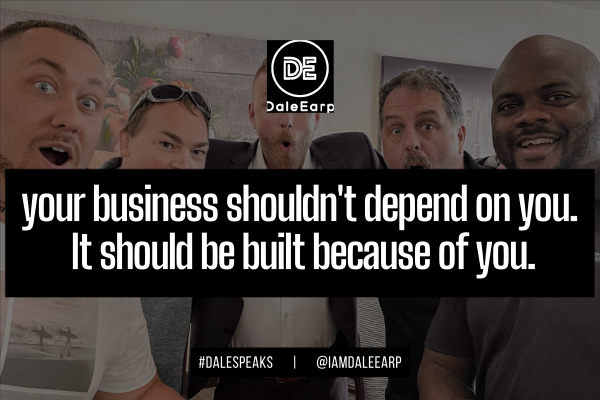
Why Your Business Can't Grow Without Letting Go
There’s a conversation I’ve had with dozens of entrepreneurs over the years, and it almost always starts the same way.
They tell me business is growing. Revenue is up. The team is getting bigger. There are more opportunities than ever before.
Then, almost without fail, they say something like this:
"I feel like I'm working harder now than I did when I started."
I understand exactly what they mean because I've lived it myself.
In the beginning, doing everything isn't just normal—it's necessary. You're answering sales calls during lunch, replying to customers before bed, handling marketing on weekends, and solving every problem that lands on your desk. That's what it takes to build something from nothing.
The problem is that most entrepreneurs never change. The business grows. The responsibilities multiply. The team expands. But the founder keeps operating like it's still day one.
That's when growth quietly turns into a trap.
One of the biggest lies entrepreneurs tell themselves is, "Nobody can do it as well as I can."
Sometimes that's true. At least for a while.
You've spent years learning your customers, understanding your products, and developing your standards. Of course you'll be better than someone who's only been with you for six months.
But here's the question very few founders ask themselves.
Is being the best person to do the work still the best thing for the business?
Those are two completely different questions.
Just because you can do something doesn't mean you should.
The moment everything depends on one person, growth becomes limited by that person's time, energy, and attention. It doesn't matter how talented you are. There are only so many hours in a day.
Eventually, your business hits a ceiling.
Not because demand disappeared. Not because your market changed.
Because every important decision still has to go through you. That's what a bottleneck looks like. The frustrating part is that it doesn't feel like poor leadership. It feels like responsibility.
You tell yourself you're protecting quality.
You're making sure customers have a great experience.
You're helping your team avoid mistakes.
Those are good intentions. But intentions don't always produce healthy businesses. In reality, many founders unintentionally teach their teams to become dependent on them.
Every time an employee asks a question and you immediately provide the answer, you're solving today's problem. But you're also reinforcing tomorrow's dependency. Instead of teaching someone how to think, you've taught them to wait. Eventually, people stop making decisions because they're afraid of making the wrong one.
Projects slow down. Meetings increase. Emails pile up. Everyone waits for the founder.
And the founder starts wondering why nothing moves without them.
The answer is simple.
Because that's exactly how the business has been trained to operate.
One of the biggest mindset shifts I've ever had was realizing that leadership isn't about having all the answers.

Leadership is about building people who can find answers without you.
That's much harder. It requires patience. It requires trust. It requires accepting that someone else might not do something exactly the way you would.
For a lot of entrepreneurs, that's uncomfortable.
Perfection feels safer than delegation. Control feels safer than trust. Doing it yourself feels faster than teaching someone else. And to be honest, sometimes it is faster.
The first time.
Teaching someone how to complete a task might take an hour today, but it could save hundreds of hours over the next year. That's not wasted time. That's an investment. The businesses that scale understand this. They don't build heroes. They build systems.
They don't create employees who constantly ask, "What should I do?"
They create leaders who confidently ask, "Here's what I think we should do. Do you agree?"
That's a completely different culture. It's the difference between management and leadership. Management controls. Leadership develops. One creates dependency. The other creates capacity.
I've also learned that letting go doesn't mean lowering your standards.
It means documenting them.
If quality only exists because you're personally checking every detail, then quality isn't actually built into your business. It's built into you. That's a dangerous place to be.
The strongest organizations don't rely on memory. They rely on processes. They create systems that allow ordinary people to produce extraordinary consistency.
That's one of the reasons we built Connect.
As businesses grow, communication becomes one of the biggest bottlenecks. Customer conversations happen in one place, leads are stored somewhere else, follow-ups live in someone's notebook, and the founder becomes the only person who knows where everything is.
That's exhausting.
Connect wasn't designed to give entrepreneurs another piece of software to manage. It was designed to remove founder dependency by giving the entire team access to the information they need to keep moving. Because when everyone has clarity, fewer questions come back to the founder. And that's exactly where growth begins.
One thing I want to be clear about is this. Building a business that doesn't depend on you doesn't make you less valuable. It makes you more valuable. Your role simply changes. Early on, your value comes from doing. Then it comes from deciding. Eventually, it comes from thinking.
The founder who spends every day answering routine questions has very little time left to cast vision, build relationships, improve strategy, or create new opportunities. That's where businesses get stuck. Not because they're missing talent. Not because they're missing customers. Because the founder is spending all day inside the business instead of leading it. One exercise I encourage every business owner to try is surprisingly simple.
Imagine you had to leave tomorrow for two weeks.
No laptop.
No phone.
No email.
What would happen?
Would sales continue?
Would customers still receive excellent service?
Would projects move forward?
Would your team confidently make decisions?
Or would everything pause until you came back?
The answer to that question tells you more about your business than any profit and loss statement ever will. A healthy business shouldn't require the founder's constant presence to survive. It should require the founder's vision to continue growing.
Those are two very different things.
If you're still carrying everything yourself, don't feel discouraged. Most entrepreneurs start there. The important part is recognizing when it's time to evolve. This week, don't try to let go of everything.
Just choose one thing.
One meeting someone else can lead. One decision someone else can make. One process you can document. One responsibility you can trust another person to own.
Small changes create momentum. Momentum creates confidence.
Confidence creates leaders. And leaders build businesses that continue growing long after the founder steps away.
That's the goal.
Not to become unnecessary. But to build something strong enough that it no longer depends on you for every single step. Because the greatest businesses aren't built by founders who refuse to let go.
They're built by leaders who understand that real growth begins the moment they do.
Legacy doesn't build itself.
Want to go deeper? Read this next: The Legacy You're Building Starts Today


