Why Growing Too Fast Can Destroy a Business
A lot of entrepreneurs have the same dream.
They want more customers. More revenue. More opportunities. More people knowing their name. They want the business they imagined when they first started.
And there’s nothing wrong with that.
Growth is exciting. Growth means something is working. It means the effort, sacrifice, and late nights are producing results. But there is something I’ve learned after spending years building businesses and being around other entrepreneurs.
Growth itself is not the goal. Sustainable growth is.
Because getting bigger is easy compared to staying strong. A lot of businesses don't fail because they couldn't grow. They fail because they grew faster than they were prepared to handle.
That’s a conversation most people don’t want to have. Everyone celebrates the revenue milestone. Everyone celebrates the new clients, the bigger team, the expansion, and the momentum.
But very few people talk about what happens when the foundation underneath that growth isn't strong enough. And that’s where the real challenge begins.
I remember seeing a construction project where the team was preparing the foundation before anything visible had been built. To someone walking by, it probably looked like nothing was happening. There was no impressive structure yet. No finished building. No reason for anyone to stop and take a picture.
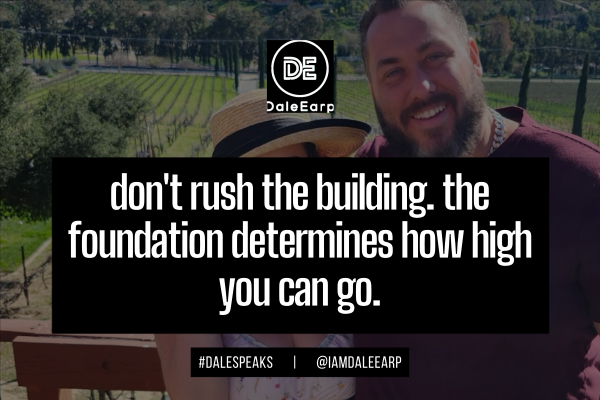
But the people who understood construction knew exactly what was happening. The most important part of the building was being created underground. The foundation determines everything that comes after it.
A weak foundation doesn't become stronger because you add more floors on top of it. Eventually, the weight exposes the problem. Business works the same way. Entrepreneurs often want the next level before they’ve built the structure required to support it.
They want more clients before they have reliable systems.
They want more employees before they have leadership structure.
They want more revenue before they understand their numbers.
They want more attention before they have the operations to deliver consistently.
And because growth feels exciting, they mistake movement for progress. But movement doesn't always mean you're moving in the right direction. Sometimes you're just creating more problems faster.
One of the biggest traps entrepreneurs fall into is believing that doing everything themselves is the reason they are successful.
At the beginning, it makes sense. When you're starting out, you wear every hat. You handle the customers. You answer the messages. You make the decisions. You solve every problem. That season is normal.
But eventually, the same habits that helped you start become the things preventing you from growing. The entrepreneur becomes the bottleneck. Every decision has to go through them. Every question needs their approval. Every problem becomes their responsibility. And slowly, the business stops becoming something they own and starts becoming something that owns them.
This is one of the hardest transitions for founders because letting go feels risky.
You built it.
You understand it.
You care about it more than anyone else.
So naturally, you think, "If I want it done right, I have to do it myself." But that mindset creates a ceiling. Because a business that depends completely on the founder has a limit.
Your time becomes the limit.
Your energy becomes the limit.
Your attention becomes the limit.
And no matter how talented or hardworking you are, you only have so much capacity. The goal isn't to become less important. The goal is to build something where your importance comes from vision and leadership, not from being the person who fixes everything. That is the difference between owning a business and operating a job.
Real growth requires the courage to build beyond yourself. That means creating systems. It means documenting processes. It means developing people. It means creating an environment where decisions can be made without everything stopping at your desk.
This is why I believe infrastructure matters more than speed. Because speed without structure creates chaos. A company can survive being small with bad systems. A company cannot survive being large with bad systems.
The problems that were manageable with five customers become overwhelming with five hundred. The communication issues that were annoying with a small team become destructive with a larger one.
The lack of process that felt flexible in the beginning becomes confusion later. Growth doesn't fix those things. Growth magnifies them.
That’s why successful entrepreneurs have to think differently. They stop asking, "How do I get more?"
And they start asking, "What needs to be stronger before I get more?" That question changes everything. Because sometimes the smartest move is not expansion.
Sometimes the smartest move is preparation. It’s slowing down long enough to build the machine that can handle the next level. This is also why systems and technology are such a critical part of modern businesses.
The purpose of technology shouldn't be to make entrepreneurs busier.
It should create capacity.
It should remove unnecessary friction.
It should allow businesses to operate with more clarity.

That’s exactly why we built EARPware.
Because entrepreneurs shouldn't have to spend their entire day managing scattered conversations, chasing information, and manually handling repetitive tasks that pull them away from higher-level thinking.
Tools like Connect help businesses organize communication and customer relationships so growth doesn't create unnecessary confusion. Social PowerPlay helps maintain consistency and visibility without requiring entrepreneurs to constantly live inside their content. AI Infinity helps reduce repetitive work so business owners can focus more energy on strategy, leadership, and decisions that actually move the company forward.
The goal isn't replacing the human side of business. The goal is protecting the human side. Because the best ideas, decisions, and leadership come from people who have the mental space to think.
And that brings me back to the question every entrepreneur should ask before chasing the next level:
If my business doubled tomorrow, would my foundation support it?
Would your team be ready?
Would your systems hold?
Would your customers experience better service or more chaos?
Would you become more free, or would you become more trapped?
Those answers matter. Because the next level doesn't just require ambition.
It requires capacity. The businesses that last are not always the ones that grow the fastest. They are the ones that build strong enough foundations to keep growing after everyone else burns out.
There is nothing wrong with wanting more.
More impact.
More revenue.
More opportunities.
More freedom.
But make sure you're building something that can carry the weight of everything you're asking for. Because growth is a responsibility.
And the question isn't whether you can reach the next level. The question is whether you've built something strong enough to stay there.
Build the foundation. Strengthen the systems. Develop the people. Earn the right to scale.
Because sustainable growth isn't about becoming bigger overnight.
It's about becoming stronger every day.
Legacy doesn't build itself.
Want to Go Deeper? If this challenged the way you think about progress, don't stop here.
Read next: Mental Toughness Isn't Loud


