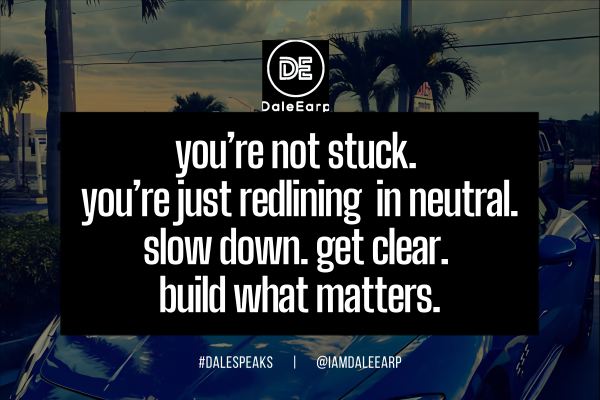
You’re Not Stuck! You’re Just Moving Too Fast to Think
Let’s talk about feeling “stuck.” Most people throw that word around like it’s a permanent condition or a stroke of bad luck. It isn’t.
In my experience, you’re almost never actually stuck. You’re just moving too fast to think. You’re redlining the engine in neutral and wondering why the scenery isn't changing.
It’s a common trap for capable people. It isn’t a lack of opportunity or a lack of effort holding you back. It’s the fact that you’ve traded your vision for a checklist. You’ve replaced your blueprint with a blur of activity, and you’ve lost the ability to actually see the site you’re building.
"Activity without direction is just wasted energy. You can't lead a crew if you're too busy swinging the hammer to look at the map."
The View from the Top Floor
When you get into rooms with people building real wealth and massive impact, you notice a pattern. They aren’t the ones franticly checking notifications or sprinting through the hallways. The heavy hitters are the most intentional thinkers in the room. They pause. They ask the uncomfortable questions that make everyone else squirm. They take the time to measure twice so they only have to cut once. Because of that, they make fewer mistakes, and their momentum compounds while everyone else is busy fixing errors they were too rushed to avoid.
Why We Sprint Into the Wall?
Slowing down sounds simple, but for a builder, it’s the hardest discipline to master. Why? Because slowing down forces you to be honest. When you stop moving, you have to look at the foundation. You have to ask:
“Is this actually working? Am I building a legacy, or am I just staying busy to avoid the truth that I’m headed in the wrong direction?”
That honesty is painful. So, instead of facing it, most people double down on the noise. They add more tasks, more meetings, and more "hustle," hoping that if they just go fast enough, the cracks in the foundation won't matter.
Spoiler alert: The cracks always matter.
Engineering Better Thought
Thinking isn’t a passive hobby; it’s a high-level discipline. To do it right, you need three things:
Space: You can't see the blueprint if you're standing an inch away from the wall.
Honesty: You have to be willing to admit when a project is a dead end.
Patience: Real results don't happen in the "sprint"; they happen in the strategy.
Once you develop the discipline of thinking, your results change. Your decisions sharpen. Your strategy becomes a weapon instead of a guess.
This is exactly why I built EARPware. I realized that most entrepreneurs are stuck in the "noise" of manual labor—handling leads, managing follow-ups, and fighting fires. If you’re spinning your wheels, it’s usually because your systems are demanding your movement instead of supporting your thinking. With AI Infinity, you can offload the "busy work" to an AI employee that doesn't need to sleep. But you also need a command center. That’s where Connect comes in. It’s the All-In-One CRM that pulls your entire operation into one dashboard. When your data is organized, your mind is clear. You stop reacting to the chaos and start commanding the build.
Stop asking, "What should I do next?" and start asking, "What actually matters right now?"
The right move at the right time will always outperform constant, mindless motion. Get clear. Get intentional. Get back to building.
Legacy doesn’t build itself.
Want to go deeper? Read this next: Maintenance for the Machine


