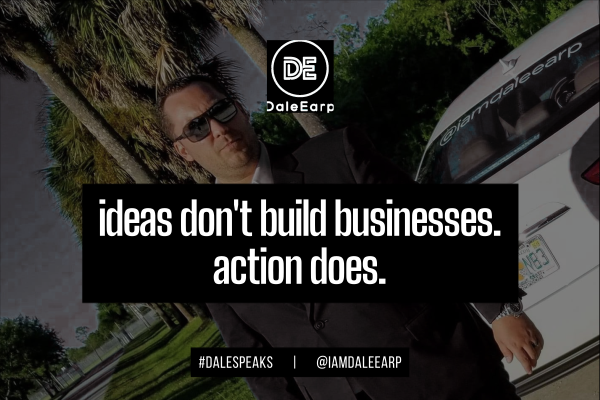
Action Creates Clarity: Why You Have to Move Before You Know Everything
There is a quote attributed to Pablo Picasso that I've always liked: "Action is the foundational key to all success."
It's simple, but I think we make success far more complicated than it needs to be. We look for the perfect strategy, the perfect timing, the perfect business model, the perfect opportunity, and the perfect amount of confidence before we're willing to move. We tell ourselves we're being strategic when sometimes we're really just afraid of making the wrong decision.
I've watched entrepreneurs spend months preparing to do something that could have been tested in a week. They'll research the market, compare competitors, build spreadsheets, redesign the website, change the offer, rethink the name, and have conversation after conversation about what might happen. Eventually, they know everything there is to know about the idea except one thing: whether it actually works.
That's where action becomes so important.
You can think about a decision for a long time, but thinking has a limit. At some point, you need reality to participate in the conversation. You need customers to respond. You need a team to test the process. You need the market to give you feedback. You need to make the phone call. You need to launch the offer. You need to have the difficult conversation. You need to take the first step.
Because action gives you information that planning cannot. This doesn't mean you should act recklessly. There's a major difference between thoughtful action and impulsive action. Thoughtful action means you've considered the risks, identified what you know, identified what you don't know, and taken the next reasonable step. Impulsive action is moving simply because you're uncomfortable sitting still.
Builders understand the difference.
They don't need to know exactly how everything will unfold before they begin. They need enough information to take the next intelligent step. That's an important distinction because business rarely gives you the entire map.
When you're building something new, there will always be variables you can't predict. Customers may behave differently than you expected. A strategy that looked perfect on paper may perform poorly in the real world. A team member may respond differently than you anticipated. An opportunity may appear that wasn't part of the original plan.
That's not failure. That's information. And information becomes useful when you're willing to do something with it. One of the biggest misconceptions about clarity is that you have to find it before you act. I've found that the opposite is often true.
Action creates clarity.
You take a step and learn something. That lesson changes your understanding. Your understanding changes your next decision. The next decision creates another result. That result gives you more information. Eventually, the path becomes clearer because you've walked far enough to see it. You couldn't have seen that path from where you started.
That's why some people stay stuck for years. They're standing at the beginning of the road demanding to see the entire route before they take the first step. It doesn't work that way.
Think about building a house. You can have architectural plans, measurements, materials, and a schedule, but eventually somebody has to put the first piece of the structure in place. Construction doesn't happen because everyone understands the blueprint. It happens because someone starts building.
Business is no different.
Ideas need execution.
Strategies need testing.
Vision needs movement.
Without action, even a great idea has no opportunity to become reality.
There's another reason people avoid action: they believe action requires confidence. They wait until they feel ready. But confidence is often a result of action rather than a prerequisite for it.
Think about the first time you did something that eventually became easy for you. Maybe it was making sales calls, leading a meeting, speaking in front of people, hiring someone, negotiating a deal, or launching something of your own. The first few times probably felt uncomfortable. You didn't have much evidence that you were capable of doing it well.
Then you did it again. And again. And again. Eventually, what once required enormous mental energy became familiar. That's what action does. It creates evidence.
You prove to yourself that you can handle the thing you were afraid of handling. Then your confidence grows. This is particularly important for entrepreneurs because entrepreneurship constantly asks you to operate without complete certainty. There will always be another decision you could postpone. Another risk you could analyze. Another piece of information you could collect.
If you're waiting for certainty, you'll wait forever. The better question is, "What do I know right now, and what can I learn by taking the next step?"
That question creates movement without encouraging recklessness. Maybe you don't know whether your new offer will work. Test it. Maybe you don't know whether a new process will improve your team's performance. Run a small pilot. Maybe you don't know whether customers want a new service. Talk to them. Maybe you're unsure whether a new hire will work out.
Define expectations, create accountability, and evaluate the results. You don't need to solve every uncertainty before moving. You need to create a way to learn from it. That's how strong businesses are built. And it's also why small action matters.
People often think action has to mean something dramatic. They imagine launching the company, hiring twenty people, signing a massive client, or making some giant life-changing decision.
But most meaningful progress isn't dramatic. It's sending the email. Making the call. Testing the idea. Fixing the process. Having the conversation. Writing the first version. Asking the question. Following up. Doing the thing you've been postponing.
Small actions create momentum because they reduce the psychological weight of the next action.
Once you start moving, movement becomes easier. That's why I pay so much attention to execution. A business can have incredible ideas and still go nowhere if nobody is responsible for turning those ideas into reality.
This is also where systems become important.
Action creates momentum, but unmanaged momentum can create chaos. As a business grows, the founder can't personally remember every follow-up, every conversation, every piece of content, and every operational detail.
That's why infrastructure matters. Tools like Connect can help organize communication and relationships. Social PowerPlay can help businesses maintain consistency and visibility without requiring the founder to manually manage every social task. AI Infinity can help reduce repetitive work and give entrepreneurs more room to focus on higher-value decisions.
The purpose of technology isn't to replace action. It's to remove friction from action. The more unnecessary work you eliminate, the more capacity you create for meaningful execution. And that's the bigger lesson. You don't need to become someone who is constantly busy. You need to become someone who consistently moves the right things forward.
There's a difference between activity and action. Activity can make you feel productive without producing anything meaningful. You can answer emails all day and still avoid the decision that actually matters. You can attend meetings for eight hours and never solve the problem everyone is meeting about. You can reorganize your task list ten times and still not make the phone call you've been avoiding.
Action is different. Action changes something. It creates information. It creates progress. It creates consequences that you can respond to.
Sometimes those consequences will be positive. Sometimes they'll show you that your original idea wasn't right. Both outcomes are valuable. Because knowing what doesn't work is still progress when it prevents you from wasting another year doing it. That's something I wish more entrepreneurs understood.
A wrong decision that teaches you something can be more valuable than a perfect plan that never gets tested. The people who build lasting businesses aren't necessarily people who make every decision correctly. They're people who learn quickly. They move. They observe. They adjust. They keep going. That's the rhythm.
Action. Feedback. Adjustment. Action again. Over time, that cycle becomes momentum. And momentum is powerful.
Not because it means everything is suddenly easy, but because you're no longer standing still wondering what might happen.
You're learning. You're building. You're becoming more capable.
So if there's something you've been thinking about for weeks, months, or even years, ask yourself whether you actually need more information—or whether you simply need to take the next reasonable step. Maybe you don't need another podcast. Maybe you don't need another book. Maybe you don't need another strategy session. Maybe you need to make the call. Send the proposal. Launch the first version. Have the conversation. Test the idea.
Start.
You don't have to know exactly where the road ends. You just need enough courage and clarity to take the next step. Because clarity often comes after movement. Confidence often comes after experience. Momentum often comes after the first uncomfortable decision to begin.
That's why action is foundational. It turns ideas into reality. It turns knowledge into experience. It turns experience into judgment. And over time, it turns small decisions into something much bigger than any single action could have created.
That's how builders operate. They don't wait for perfect conditions. They build with what they have, learn from what happens, and keep improving the structure. So stop waiting for the perfect moment.
Take the next step. Then take another.
Keep building.
Legacy doesn't build itself.
Want to Go Deeper? If this challenged the way you think about progress, don't stop here.


